After understanding the client’s requirements, we provide product samples for quality evaluation, enabling confident and... informed purchasing decisions. Read More
After evaluating the samples, the client confirms the order, following which 50% of the total payment is to be made to initiate... the production process. Read More
Next, the products are manufactured under strict quality standards, ensuring consistency, compliance and timely production.
Next, we perform export-standard packaging with complete transparency and quality assurance. The entire packaging... process is recorded and shared with the client. For exports by air and road, the remaining 50% payment is required at this stage before shipping. Read More
Next, we ship the packages through trusted logistics partners and share scanned copies of all necessary export documents with... the client via email. For sea shipments, the remaining 50% payment is to be completed upon receiving the scanned documents. Read More
Next, we courier the original copies of all required export documents needed for customs clearance and import procedures... in the client’s country. This step is especially important for sea shipments. Read More
We kindly request our clients to record the cargo opening process from start to finish, as the footage may be required for... verification purposes in the event of any discrepancies or insurance claims. Read More
We request our clients to please contact us in the event of any discrepancies and allow us the opportunity to resolve the matter... promptly and professionally. Read More
We collect client feedback to evaluate satisfaction, enhance our services, and build long-term business relationships.
20/10 Northern Avenue, Kolkata - 700037, India
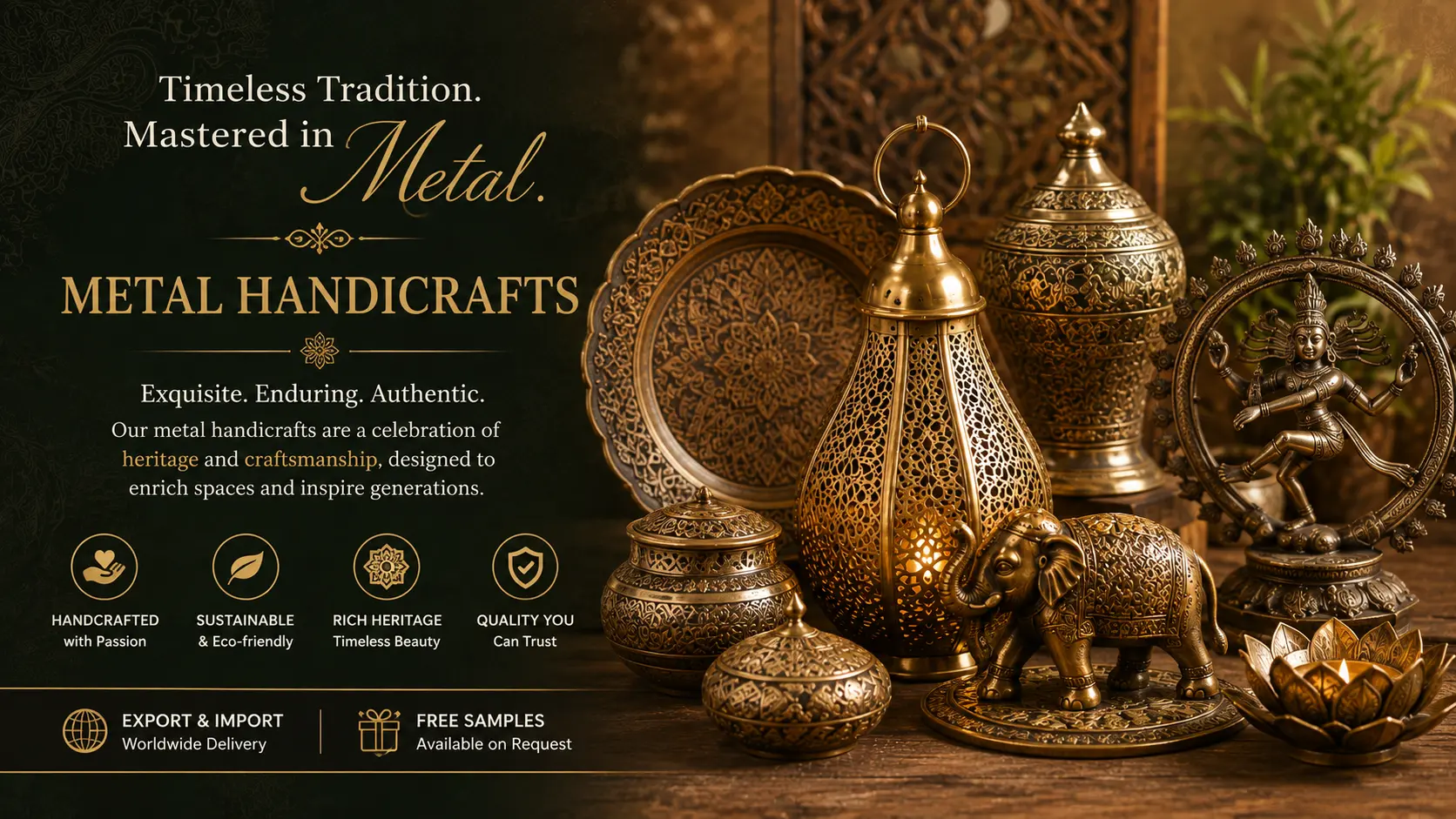
A brass tray on a dining table does not need much explanation. It catches the light, adds something to the setting and can still be used rather than simply looked at. A small figurine can do something similar on a bookshelf. Even an old fashioned looking metal box can find a place in a modern home when the shape and finish are right.
That is part of the attraction of metal handicrafts. They can be decorative, useful, traditional or quite contemporary. For a business selling home accessories, gifts or lifestyle products, this leaves plenty of room for selection.
India has many craft traditions based around brass, copper, bronze, iron and other metals. Different regions have developed their own techniques and styles, giving buyers plenty of scope to find products that feel distinctive rather than mass produced.
Think about the sort of shop where these products might be sold. A home décor store may want bowls, trays and sculptures. A gift retailer may be more interested in smaller pieces that are easy to display and ship. A hotel could require decorative objects in considerable numbers.
Then there are buyers who want products with a strong connection to Indian craft traditions.
Figurines, lamps, candle holders, boxes, wall pieces, decorative vessels and metal ornaments can all fall within the category. Some are intended primarily for display. Others are designed to be used every day.
That distinction matters when choosing products for resale. A large sculpture may make sense for an interior project but be inconvenient for an online retailer dealing with individual shipments.
The phrase metal handicrafts exports from India covers a broad range of art metalware and related handcrafted products. Art metalware is recognised as an Indian handicraft export category, with overseas markets including the USA, UAE, UK and Germany.
For an importer, however, the export statistics are only the beginning of the conversation.
The product still has to work. A retailer needs something that customers will actually pick up and consider buying. A wholesaler needs sensible pricing and quantities. A hospitality project may require several pieces with a consistent appearance.
The same metal article can therefore be a good choice for one business and a poor one for another.
Metal is not simply a material choice. It affects the personality of the finished product.
Brass can give a decorative piece a warm appearance. Copper has its own colour and character. Bronze can lend itself to sculptural work, while iron can produce a more solid or rustic look.
The surface treatment changes things again. A bright polished finish has a different feel from an aged surface, brushed texture or darker patina.
When discussing a product with a supplier, these details are worth spelling out. A reference photograph is often more useful than a long description, especially when the buyer already has a particular appearance in mind.
This is an easy question to overlook.
A decorative bowl may sit on a console. A tray might be used for serving. A candle holder has to remain stable. A wall decoration needs suitable mounting arrangements. A figurine needs to arrive without delicate parts being damaged.
The intended use affects the product specification.
It also affects the packaging. Something small and sturdy may require little protection. An intricate object with thin projections may need considerably more care during packing and transport.
For an importer, these are not minor details. They can affect the cost of the shipment and the condition in which the goods reach the customer.
Businesses looking for metal handicrafts exporters in India may approach suppliers with very different levels of preparation.
Some already have a finished product in mind. They may have measurements, photographs and a target quantity. Others are at the earlier stage of deciding what kind of Indian metalware would suit their customers.
Both approaches are possible.
If you have a reference product, share it. If you are building a new collection, explain the type of store, customer or project involved. A supplier can then be considered in relation to what actually needs to be produced rather than simply whether the supplier makes metal handicrafts.
India's handicraft sector includes established craft clusters and a large network of artisans and producers. Government handicraft resources also cover export promotion, product development, packaging and international market information.
Metal has a habit of looking different in photographs.
The weight may surprise you. A surface that appears smooth on screen may have considerable texture. Details in engraving or casting may be less prominent than expected. The proportions can also seem different when the object is sitting in front of you rather than on a screen.
A sample gives the buyer something concrete to judge.
This can be particularly helpful when the intended order is large or when a product will carry the buyer's own branding. It is much easier to discuss a change when both sides are looking at the same physical piece.
The first order and the fifth order may not look the same from a buyer's perspective.
At the beginning, the concern may simply be whether the products sell. Later, the ability to obtain another batch becomes more important. A retailer does not want a successful product to disappear just when customers have started asking for it.
Quantities, production capacity, packaging and expected delivery schedules should therefore be discussed before a product becomes a regular part of the range.
Not every handcrafted article will have exactly the same appearance from one piece to another. Buyers dealing in handmade goods should decide in advance how much natural variation is acceptable.
The destination market can influence the buying decision in ways that are not immediately obvious.
A product intended for a specialist décor store may be selected for its unusual design. A gift retailer may prefer compact pieces with straightforward packaging. A hotel or restaurant could be more concerned with quantities, durability and consistency.
The selling price matters too. Freight and import costs should be considered alongside the product price before deciding whether an item makes commercial sense.
This is where a clear sourcing brief becomes useful.
You do not need a long list of products to begin.
Send a photograph if you have one. Mention the approximate quantity and where you intend to sell the goods. If you know the preferred metal, dimensions or finish, include those details as well.
If you are still looking for ideas, explain the type of collection you want. A home décor range, gift assortment and hospitality project will each call for a different approach.
Trade Horizon helps international businesses explore Indian metal handicraft sourcing according to these practical requirements. The process can begin with one product or with a broader idea of what you want your collection to look like.